What Is a Recipe Conversion Calculator?
A Recipe Conversion Calculator is a free online tool that converts ingredient measurements and helps you adapt recipes to suit your needs. Continue
Free Recipe Conversion Calculator – Convert Cooking and Baking Measurements
Have you found a recipe that uses cups instead of grams? Perhaps you’re following an American recipe but prefer UK measurements, or you need to convert ounces into grams before you start baking.
Our free Recipe Conversion Calculator makes it easy to convert common cooking and baking measurements without complicated calculations.
Whether you’re baking a cake, preparing a family dinner or following a recipe from another country, our online kitchen converter helps you measure ingredients more accurately.
You can use the recipe conversion calculator to:
- Convert grams, kilograms, ounces and pounds.
- Convert millilitres, litres, teaspoons, tablespoons and cups.
- Convert selected ingredients between weight and volume.
- Increase or decrease recipes for different numbers of servings.
- Convert oven temperatures between Celsius, Fahrenheit and UK Gas Marks.
Simply select the conversion you need, enter your measurement and let the calculator do the work.
Recipe Conversion Calculator
Convert ingredients, scale recipes and check oven temperatures
Ingredient selection matters when converting between weight and volume.
Add each ingredient and its original amount. The calculator will scale the quantities automatically.
Quantities are shown beside each ingredient above.
Free kitchen calculator from Calculator Central. Results are estimates for cooking and recipe planning, not a substitute for recipe-specific instructions or food-safety checks.
What Is a Recipe Conversion Calculator?
A Recipe Conversion Calculator is a free online tool that converts ingredient measurements and helps you adapt recipes to suit your needs.
Different cookbooks and recipe websites use different measurement systems.
For example, British recipes commonly use grams and millilitres, while many American recipes use cups, tablespoons and ounces.
This can make following an unfamiliar recipe confusing, particularly when baking, where ingredient measurements can affect the finished result.
Our cooking measurement converter helps you switch between these units quickly.
It is particularly useful for converting recipes from American measurements to UK metric measurements.
How to Use Our Recipe Conversion Calculator
Our calculator includes three useful conversion tools.
1. Ingredient Measurement Converter
Use this option when you want to convert an ingredient from one measurement unit to another.
For example, you might want to convert:
- 8 oz of flour into grams.
- 250 ml of milk into cups.
- 2 tablespoons into millilitres.
- 500 g into pounds.
- 1 cup of caster sugar into grams.
Enter the quantity, choose the original measurement unit and select the unit you want to convert to.
For conversions between weight and volume, select the appropriate ingredient where available.
This is important because different ingredients have different densities.
2. Recipe Serving Size Converter
Use the recipe scaling feature when you want to prepare more or fewer portions than the original recipe.
For example, if a recipe serves four people but you need six portions, the calculator can help you work out the adjusted ingredient quantities.
The basic formula is:
New Ingredient Quantity = Original Quantity × (Required Servings ÷ Original Servings)
This is useful when cooking for guests, reducing recipes for smaller households or preparing extra portions.
3. Oven Temperature Converter
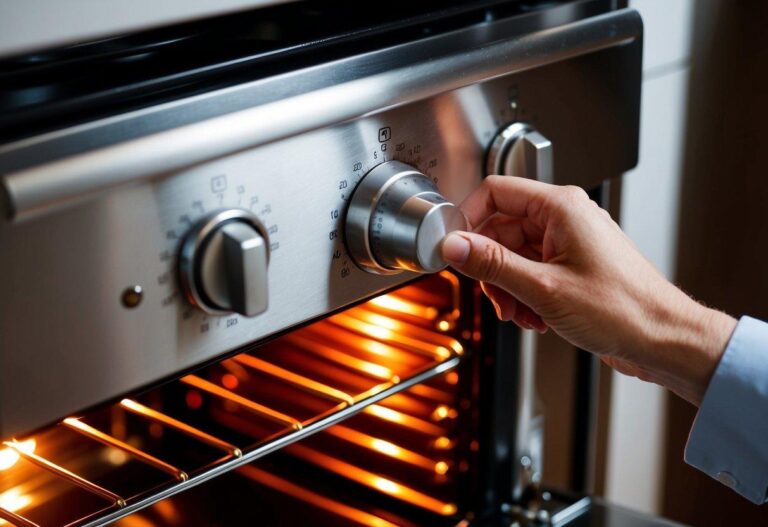
Use the oven conversion feature when a recipe specifies a temperature in a different format.
You can compare common settings in Celsius, Fahrenheit and UK Gas Marks.
This is particularly helpful when following American baking recipes or traditional British recipes that use Gas Marks.
Cooking Measurement Conversion Chart
The following table shows common conversions used in UK cooking and baking.
| Original Measurement | Equivalent |
|---|---|
| 1 kilogram | 1,000 grams |
| 1 pound (lb) | Approximately 454 grams |
| 1 ounce (oz) | Approximately 28.35 grams |
| 100 grams | Approximately 3.53 ounces |
| 1 litre | 1,000 millilitres |
| 1 UK teaspoon | 5 ml |
| 1 UK tablespoon | 15 ml |
| 1 US customary cup | Approximately 237 ml |
| 1 US fluid ounce | Approximately 29.57 ml |
| 1 imperial fluid ounce | Approximately 28.41 ml |
Important: A cup measures volume, not weight. The weight of one cup depends on the ingredient being measured. Cup conventions can also vary between countries, so check which measurement system your recipe uses.
How to Convert Grams to Cups
One of the most common baking questions is how to convert grams into cups.
Unlike converting grams into ounces, there is no single conversion factor that works for every ingredient.
This is because grams measure weight, while cups measure volume.
For example, a cup of flour weighs considerably less than a cup of sugar.
Common Grams to Cups Conversion Examples
The following figures are approximate, based on a US customary cup of about 237 ml.
| Ingredient | Approximate Weight per Cup |
|---|---|
| Plain flour | 120 g |
| Caster sugar | 200 g |
| Granulated sugar | 200 g |
| Butter | 227 g |
| Milk | 245 g |
| Water | 237 g |
| Rolled oats | 80 g |
These are general reference values. Actual weights depend on the ingredient, brand, measuring method and how tightly the cup is filled.
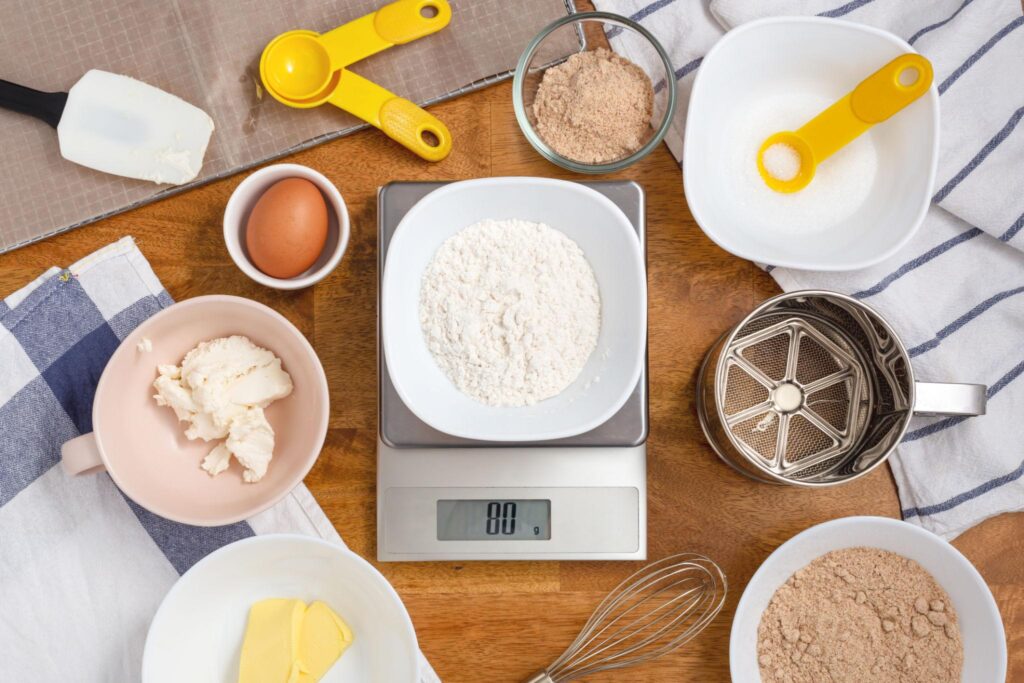
For greater accuracy when baking, use digital kitchen scales whenever possible.
How Many Grams Are in an Ounce?
One international avoirdupois ounce is equal to approximately 28.35 grams.
To convert ounces into grams, multiply the number of ounces by 28.3495.
For example:
8 oz × 28.3495 = 226.8 g
This is commonly rounded to 227 g.
Ounces to Grams Conversion Chart
| Ounces | Grams |
|---|---|
| 1 oz | 28.35 g |
| 2 oz | 56.70 g |
| 3 oz | 85.05 g |
| 4 oz | 113.40 g |
| 6 oz | 170.10 g |
| 8 oz | 226.80 g |
| 12 oz | 340.19 g |
| 16 oz | 453.59 g |
This conversion is useful when following older British cookbooks and recipes that use imperial weights.
How to Convert Cups to Millilitres
Cups are commonly used in American recipes to measure liquids and dry ingredients.
For liquids, converting cups into millilitres is straightforward once you know which cup standard the recipe uses.
One US customary cup is approximately 236.6 ml, often rounded to 237 ml.
US Cups to Millilitres Chart
| US Cups | Approximate Millilitres |
|---|---|
| ¼ cup | 59 ml |
| ⅓ cup | 79 ml |
| ½ cup | 118 ml |
| ¾ cup | 177 ml |
| 1 cup | 237 ml |
| 1½ cups | 355 ml |
| 2 cups | 473 ml |
| 3 cups | 710 ml |
| 4 cups | 946 ml |
Some recipes use a 250 ml metric cup instead. Australian and other international recipes may follow different conventions.
Always check the recipe’s country of origin where possible.
Teaspoon and Tablespoon Conversions
Teaspoons and tablespoons are commonly used for smaller quantities of ingredients such as baking powder, spices, oils and flavourings.
In standard UK metric cooking measurements:
- 1 teaspoon = 5 ml
- 1 tablespoon = 15 ml
- 1 tablespoon = 3 teaspoons
- ½ tablespoon = 7.5 ml
- ½ teaspoon = 2.5 ml
- ¼ teaspoon = 1.25 ml
Use proper measuring spoons rather than ordinary cutlery, as household spoon sizes can vary.
How to Convert American Recipes to UK Measurements
American recipes often use a combination of cups, Fahrenheit oven temperatures and ounces.
British recipes generally favour metric weights and volumes.
When converting an American recipe into UK measurements, consider three important areas.
Ingredient Weights
Convert ounces and pounds into grams and kilograms.
For example, 1 lb of butter is approximately 454 g.
Cups and Spoon Measurements
Convert cups into millilitres for liquids or use ingredient-specific weight conversions for dry ingredients.
For baking, weighing ingredients is generally more reliable than measuring them by volume.
Oven Temperatures
American recipes usually specify Fahrenheit.
For example, 350°F is approximately 177°C, commonly rounded to 180°C for a conventional oven.
If using a fan oven, you may need a lower setting depending on the recipe and manufacturer’s instructions.
Our Recipe Conversion Calculator helps you manage these different measurements in one place.
How to Increase or Decrease a Recipe
Sometimes the measurements in a recipe are correct, but the number of portions is not suitable.
Perhaps your recipe serves four people and you want to cook for eight, or you need to reduce a recipe for two.
To adjust a recipe, calculate the scaling factor:
Scaling Factor = Required Servings ÷ Original Servings
Example: Increasing a Recipe from 4 to 6 Servings
A recipe serving four people requires:
- 400 g chicken
- 200 g rice
- 300 ml stock
- 100 g vegetables
To prepare six servings, multiply every ingredient by 1.5.
| Ingredient | Original | Adjusted |
|---|---|---|
| Chicken | 400 g | 600 g |
| Rice | 200 g | 300 g |
| Stock | 300 ml | 450 ml |
| Vegetables | 100 g | 150 g |
Remember that cooking times and seasoning do not always scale proportionally with ingredient quantities.
For more detailed ingredient scaling, use our separate Recipe Serving Size Calculator.
Oven Temperature Conversions for Baking
Oven temperatures are another common source of confusion when following recipes from different countries.
The following chart shows familiar approximate oven settings.
| Conventional °C | Fahrenheit | Fan Oven °C | UK Gas Mark |
|---|---|---|---|
| 140°C | 275°F | 120°C | 1 |
| 150°C | 300°F | 130°C | 2 |
| 170°C | 325°F | 150°C | 3 |
| 180°C | 350°F | 160°C | 4 |
| 190°C | 375°F | 170°C | 5 |
| 200°C | 400°F | 180°C | 6 |
| 220°C | 425°F | 200°C | 7 |
| 230°C | 450°F | 210°C | 8 |
| 240°C | 475°F | 220°C | 9 |
These are commonly used rounded cooking equivalents, not exact mathematical conversions.
Fan oven adjustments are approximate and may vary by appliance and recipe.
Tips for Accurate Recipe Conversions
Use Digital Kitchen Scales
Digital scales are particularly useful when baking cakes, bread, biscuits and pastries.
Weighing ingredients in grams can help reduce measurement differences.
Check Whether a Recipe Uses US or UK Measurements
American and British recipes can use different conventions for cups, fluid ounces and other measurements.
The word “ounce” can also refer to weight or fluid volume, so read the recipe carefully.
Select the Correct Ingredient
When converting between grams and cups, choose the appropriate ingredient in the calculator.
A cup of flour does not weigh the same as a cup of butter or sugar.
Avoid Rounding Too Early
Small differences can become more noticeable when scaling recipes.
For precise baking, retain accurate measurements until you have calculated the final quantities.
Check Baking Times Separately
Increasing the ingredient quantities does not automatically mean increasing the cooking time by the same percentage.
Consider the depth of the mixture, the baking tin and the cooking method.
Convert Your Recipe Measurements Easily
Whether you’re following an American recipe, adapting an old family cookbook or changing ingredient quantities for a larger meal, our free Recipe Conversion Calculator provides a convenient way to handle common kitchen measurements.
Convert grams, ounces, cups, millilitres and spoon measurements, adjust recipe servings and compare oven temperatures using one simple tool.
Enter your measurements into the calculator above and get started with your next recipe.
Frequently Asked Questions
Can I convert grams to cups using this calculator?
Yes. Our Recipe Conversion Calculator supports conversions between weight and volume for selected ingredients. Choose the ingredient before converting, as different ingredients have different densities.
How many grams are in one cup?
There is no universal answer. A US cup contains approximately 237 ml by volume, but the weight depends on the ingredient. For example, one cup of plain flour is often estimated at 120 g, while one cup of caster sugar is approximately 200 g.
How many grams are in 8 ounces?
Eight ounces are approximately 226.8 grams, commonly rounded to 227 g.
How many millilitres are in one cup?
One US customary cup is approximately 237 ml. A metric cup is 250 ml.
How many teaspoons are in a tablespoon?
In standard UK metric cooking measurements, one tablespoon equals three teaspoons, or 15 ml.
Can I convert American baking recipes to UK measurements?
Yes. You can convert common ingredient measurements and oven temperatures used in American recipes into units familiar to UK cooks.
Can I double or halve a recipe?
Yes. Use the recipe scaling feature to calculate ingredient quantities for more or fewer servings.
Does the calculator adjust cooking times?
No. Ingredient scaling and measurement conversions do not automatically determine new cooking times. Cooking times depend on the food, equipment and cooking method.
Is the Recipe Conversion Calculator free?
Yes. Calculator Central’s Recipe Conversion Calculator is free to use, with no registration required.
More Free Cooking and Baking Calculators
Calculator Central offers other useful tools for home cooks and bakers.